
You've scrolled past another "unlimited earning potential" ad and felt that familiar mix of hope and skepticism. Remote sales sounds incredible on paper—six-figure income, no commute, flexible schedule. But then you see the alphabet soup of job titles (SDR? BDR? AE? Closer?) and wonder if any of these roles are actually legitimate or just MLM schemes in disguise.
Here's the truth: remote sales is one of the highest-paying career paths you can pursue without a specialized degree. At Remote Job Assistant, we track thousands of sales job postings monthly, and we consistently see entry-level positions starting at $50,000 OTE with experienced closers earning $150,000 to $200,000+. The catch? Understanding which roles match your experience level and skills—and knowing which companies actually support remote work versus those that will drag you back to an office the moment you accept the offer.
This guide breaks down everything you need to know about finding and landing a remote sales job in 2026, from understanding the different roles to targeting the right companies and negotiating competitive compensation.
Get Remote Job Tips in Your Inbox
Weekly strategies, salary data, and new opportunities
Unsubscribe anytime. No spam.
Remote Sales Roles at a Glance
Not sure which role fits your experience? Here's the quick breakdown:
| Role | What You Do | OTE Range | Experience |
|---|---|---|---|
| SDR/BDR | Prospect, qualify leads, book meetings for closers | $65K-$85K | 0-2 years |
| Account Executive | Run demos, handle objections, close deals | $120K-$180K | 2-5 years |
| High-Ticket Closer | Close pre-qualified leads for premium offers | $100K-$200K+ | 2-5 years |
| Enterprise AE | Manage complex, high-value sales cycles | $200K-$300K+ | 7+ years |
| Sales Manager | Lead teams, hit collective quotas, coach reps | $150K-$250K | 5-8 years |
For detailed explanations of each role including daily responsibilities and career progression paths, see our complete guide to SDR vs BDR vs AE sales roles.
The Remote Sales Landscape in 2026
Remote sales has transformed from a pandemic necessity into a permanent fixture of the modern workforce. According to the Bureau of Labor Statistics, sales and office occupations now have a telework rate of nearly 25%—and that number climbs significantly higher in tech-focused industries.
The shift isn't just about employee preference. Companies have discovered that remote sales teams often outperform office-based teams. Without the distractions of open floor plans and mandatory "team building," salespeople can focus on what actually matters: talking to prospects and closing deals.
The types of remote sales jobs available fall into several distinct categories, each with different experience requirements, compensation structures, and day-to-day responsibilities. Understanding these differences is critical—applying for the wrong role type wastes your time and theirs.
Remote Sales Roles Explained
Before diving into specific jobs, you need to understand the sales role hierarchy. Companies use confusingly similar titles, and about 60% use SDR and BDR interchangeably. Here's what each role actually does:
Entry-Level Roles (SDR/BDR): These positions focus on prospecting and qualifying leads. You're not closing deals—you're finding potential customers and warming them up for the closers. Perfect for career changers and those new to sales.
Mid-Level Roles (Account Executive): AEs own the full sales cycle. You take qualified leads from SDRs, run demos, handle objections, negotiate contracts, and close deals. This is where compensation jumps significantly.
Senior Roles (Closers, Enterprise AE, Sales Manager): The highest-earning individual contributors. Enterprise AEs handle large, complex deals while high-ticket closers specialize in converting warm leads into high-value sales. Sales managers lead teams and hit collective quotas.
For a complete breakdown of each role including typical career paths and compensation structures, see our detailed guide on SDR vs BDR vs AE sales roles.
Remote Sales Salaries by Role
Let's talk money. Remote sales compensation typically includes a base salary plus commission or bonus, expressed as OTE (On-Target Earnings)—what you'll earn if you hit 100% of your quota.
Based on Glassdoor's 2025 salary data, here's what remote sales professionals earn:
| Role | Base Salary | OTE (Total Comp) | Experience Required |
|---|---|---|---|
| SDR/BDR | $45,000-$60,000 | $65,000-$85,000 | 0-2 years |
| Account Executive | $70,000-$95,000 | $120,000-$180,000 | 2-5 years |
| Senior AE | $90,000-$120,000 | $150,000-$220,000 | 5+ years |
| Enterprise AE | $120,000-$150,000 | $200,000-$300,000+ | 7+ years |
| High-Ticket Closer | $60,000-$100,000 | $100,000-$200,000+ | 2-5 years |
| Sales Manager | $100,000-$130,000 | $150,000-$250,000 | 5-8 years |
OTE assumes you hit your quota. Top performers exceed this (sometimes earning 150-200% of OTE), while struggling reps may only hit 70-80%. When evaluating offers, ask about quota attainment rates across the team—if fewer than 50% of reps hit quota, that's a red flag.
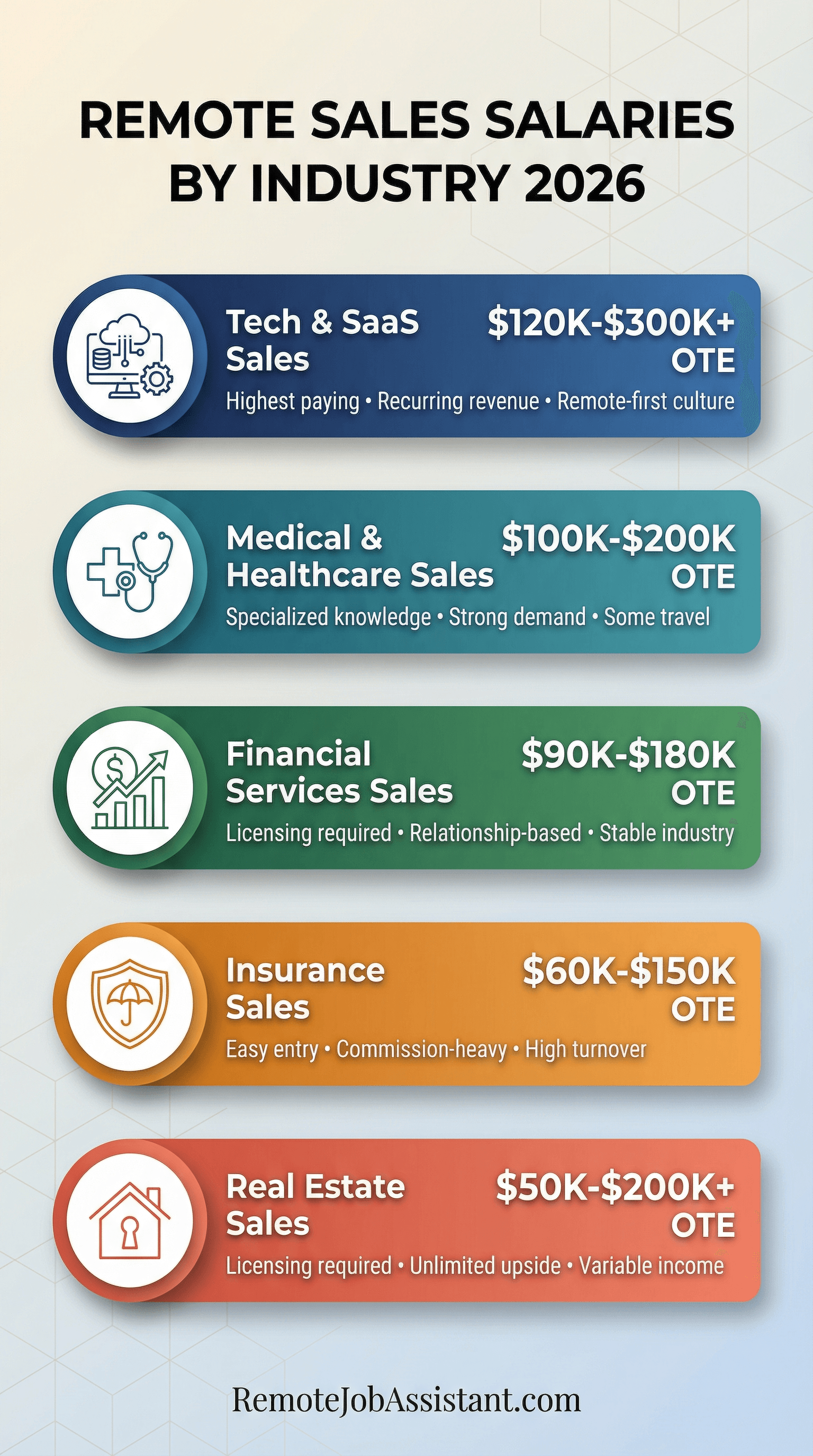
The variance in compensation depends heavily on what you're selling. Tech and SaaS sales typically pay 20-40% more than other industries, while commission-only roles (common in insurance and real estate) have unlimited upside but zero floor.
Decode Any Job Posting
Paste a job description and get instant insights: what they really want, red flags to watch, and how to stand out.
Types of Remote Sales Jobs
Remote sales spans multiple industries and selling styles. Here's where the opportunities are in 2026:
Tech & SaaS Sales
The highest-paying and most competitive segment. You'll sell software to businesses, handling everything from small business tools to enterprise platforms costing millions annually.
Why it pays well: High contract values, recurring revenue (commissions on renewals), and tech companies have embraced remote work more than any other industry.
What you'll need: Comfort with technology, ability to run virtual demos, and patience for longer sales cycles. Technical background helpful but not required—the best SaaS salespeople translate complex products into business outcomes.
Companies hiring: Salesforce, HubSpot, Zoom, Monday.com, and thousands of startups. Major tech companies like these regularly post remote sales positions.
High-Ticket Closing
A specialized niche where you close pre-qualified leads for coaching programs, courses, consulting services, and premium products typically priced $2,000-$25,000+.
Why it pays well: Commission percentages are much higher (10-20% per sale) because you're only handling the final conversion, not the full sales cycle. One sale might pay $500-$2,000+ in commission.
What you'll need: Strong phone presence, ability to handle objections confidently, and comfort with consultative selling. Most high-ticket closers work on 1099 contractor agreements.
The reality check: This space has legitimate opportunities and plenty of questionable ones. If a company wants you to pay for "training" or "leads," walk away.
Inside Sales
Phone and video-based selling for products and services across industries—from financial services to manufacturing equipment. Unlike high-ticket closing, you typically handle the full sales cycle.
Remote inside sales roles often come with more stable compensation (higher base, lower commission percentage) and tend to have more predictable hours than other sales positions.
Medical & Healthcare Sales
Selling medical devices, pharmaceuticals, or healthcare software. These roles often require industry knowledge and may involve some travel, though many have shifted to primarily remote models.
According to Bureau of Labor Statistics data, pharmaceutical sales representatives earn median wages of $102,000+, with top performers exceeding $150,000.
Insurance Sales
One of the most accessible entry points into remote sales. Companies like State Farm, Allstate, and numerous independent agencies hire remote agents to sell life, health, auto, and property insurance.
Many insurance sales positions are commission-only with high turnover. Before accepting any offer, understand the compensation structure completely. The best opportunities offer training salary or draw against commission during your ramp period.
Companies That Actually Hire Remote Sales Teams
Not all "remote" jobs are created equal. Some companies list positions as remote but expect you in-office within six months. Others are fully distributed with no headquarters at all.
Stop Applying Manually
Our AI applies to hundreds of matching jobs while you sleep. Wake up to interviews, not more applications.
Here are companies with proven track records of supporting remote sales teams:
Fully Remote-First Companies
These companies were built for distributed work. They have the infrastructure, culture, and processes to support salespeople who never set foot in an office.
Zapier — The automation platform runs a 100% remote team across 40+ countries. Known for exceptional documentation and async-first culture. Competitive compensation with equity.
GitLab — Fully remote since founding with over 2,000 team members globally. Transparent about everything from compensation to processes. Their public handbook is worth reading before any interview.
Automattic — The company behind WordPress.com operates with a distributed team of 1,900+ people. Strong emphasis on written communication and results over hours.
Deel — HR and payroll platform that practices what they sell. Rapid growth means constant hiring across sales roles.
Hybrid-Flexible Tech Companies
Large tech companies with remote-friendly sales positions, though policies vary by team and role:
HubSpot — CRM and marketing platform with thousands of sales positions. Strong training programs and clear career paths. Some roles require proximity to hubs, others are fully remote.
Salesforce — The CRM giant has embraced flexible work for many roles. Enterprise sales positions may require regional presence for client meetings.
Zoom — Ironic given their product, but Zoom maintains a "hybrid-first" approach. Many sales roles are fully remote, particularly for SMB segments.
Monday.com — Work OS platform with expanding remote sales team. Growing presence in North America with competitive compensation.
High-Growth Startups Hiring Remote Sales
Startups often offer the fastest path to senior titles and the highest risk/reward compensation:
Remote-first startups in categories like fintech, healthtech, and AI are aggressively hiring sales teams. Search remote sales positions filtered by company stage to find early-stage opportunities.
Skills You Need for Remote Sales Success
Remote sales requires everything traditional sales does, plus additional competencies for working without in-person support.
Core Sales Skills
Prospecting & Outreach: Finding potential customers through cold calling, email sequences, LinkedIn, and other channels. Even if you're in a closing role, understanding prospecting makes you more effective.
Discovery & Qualification: Asking the right questions to understand prospect needs and determine fit. This skill separates good salespeople from great ones.
Presentation & Demo Skills: Running compelling virtual presentations that keep prospects engaged when you can't read the room the same way you would in person.
Objection Handling: Addressing concerns without being defensive. Remote sales often involves handling objections over email, which requires different techniques than phone.
Closing: Moving prospects from interest to commitment. This includes everything from trial closes to negotiating final terms.
Remote-Specific Competencies
Written Communication: When you can't pop over to a colleague's desk, clear writing becomes essential. Sales emails, Slack messages, and documentation all require strong writing skills.
Self-Motivation: No one watches you work remotely. You need internal drive to make those calls, follow up on prospects, and hit activity metrics without a manager hovering.
Technical Proficiency: CRM systems (Salesforce, HubSpot), video conferencing, sales engagement platforms (Outreach, Salesloft), and whatever your company's tech stack includes.
Time Zone Management: Many remote sales roles span time zones. You'll need to schedule around prospect availability, not your preferences.
If you're transitioning from another career, many of these skills transfer. Customer service experience teaches objection handling. Teaching develops presentation skills. Any role with targets builds comfort with metrics-driven performance.
Decode Any Job Posting
Paste a job description and get instant insights: what they really want, red flags to watch, and how to stand out.
How to Land Your First Remote Sales Job
The path into remote sales depends on your current experience level. Here's the strategic approach for each starting point:
If You Have No Sales Experience
Start with SDR/BDR roles. These positions are designed for career changers and new grads. Companies expect to train you.
Where to focus:
- Companies with strong training programs (HubSpot, Salesforce, Oracle)
- Startups that value hustle over credentials
- Industries where you have domain expertise (selling software to your previous industry)
What to highlight:
- Any metrics-driven results from previous roles
- Customer-facing experience
- Relevant industry knowledge
- Coachability and work ethic
If You Have 1-3 Years of Sales Experience
You're in the sweet spot for AE roles at startups and mid-level positions at larger companies. This is where compensation jumps significantly.
Where to focus:
- Companies selling products you understand
- Growth-stage startups (Series A-C) where you can grow with the company
- Roles selling to your existing network or industry
What to highlight:
- Quota attainment numbers (percentage of target achieved)
- Deal sizes and sales cycle lengths
- Specific sales methodologies you've used (MEDDIC, Challenger, SPIN)
If You're an Experienced Sales Professional
Enterprise AE, sales management, and high-ticket closing roles become available. The market for proven performers is highly competitive.
Where to focus:
- Companies with products that match your deal-size experience
- Territories or verticals where you have relationships
- Leadership roles if you want to move into management
What to highlight:
- Career earnings and consistently exceeding quota
- Largest deals closed and how you won them
- Team impact (mentoring, process improvements)
Avoiding Remote Sales Scams
The flexibility of remote sales attracts legitimate companies and scammers alike. Here's how to protect yourself.
You pay for anything upfront. Real companies don't charge for training, leads, or equipment.
Vague job descriptions. Legitimate sales roles specify what you're selling, to whom, and compensation structure.
WhatsApp or Telegram interviews. Real companies use email, phone, or standard video platforms.
Guaranteed income claims. Sales compensation depends on performance. "Guaranteed $10K/month" is a lie.
Pressure to start immediately. Legitimate companies have hiring processes. Urgency is a manipulation tactic.
Before accepting any remote sales position, verify the company exists (check LinkedIn, Glassdoor, and news coverage), understand exactly what you're selling and to whom, and get the compensation structure in writing before signing anything.
The Application Process
Remote sales interviews typically follow a predictable pattern:
Recruiter Screen (30 min): Basic qualification, compensation expectations, timeline, and mutual interest.
Hiring Manager Interview (45-60 min): Deep dive into your experience, selling approach, and cultural fit. Expect behavioral questions about how you've handled specific sales situations.
Role Play or Demo (30-60 min): You'll either pitch the company's product or respond to an objection scenario. This is where most candidates fail—prepare extensively.
Final Round (varies): Often includes meeting the team, sales leadership, or a final presentation. Some companies add a take-home assignment.
Throughout the process, you're being evaluated on the same skills you'll use in the role: how well you communicate, handle objections, and close.
The most common mistake? Not preparing enough for role plays. Spend hours practicing your pitch, handling objections, and running mock discovery calls before any interview that might include this element.
Frequently Asked Questions
Can I get a remote sales job with no experience?
Yes. SDR and BDR roles are specifically designed for people entering sales. Companies invest heavily in training these positions because they're the pipeline for future AEs and closers. Focus on companies with structured training programs and be prepared to work hard during your first 6-12 months.
How much can I realistically earn in remote sales?
Entry-level SDRs typically earn $55,000-$75,000 OTE in their first year. After 2-3 years, AE roles pay $100,000-$150,000+. Top performers in enterprise or high-ticket closing can exceed $200,000-$300,000. Your earning potential depends on what you sell, your quota attainment, and how aggressively you pursue promotions.
What equipment do I need for remote sales?
At minimum: reliable high-speed internet (25+ Mbps), a quiet workspace for calls, a quality headset with microphone, and a computer that can run video conferencing and CRM software. Most companies provide a laptop and stipend for home office setup. Invest in good lighting and a professional background for video calls.
Do remote sales jobs require travel?
It depends on the role. Inside sales and SDR positions rarely require travel. Field sales and enterprise AE roles may require 25-50% travel for client meetings and conferences. High-ticket closing is typically 100% remote. Always clarify travel expectations during the interview process.
How do I transition from another career into sales?
Start by identifying transferable skills: customer service teaches objection handling, teaching develops presentation abilities, any metrics-driven role builds comfort with targets. Apply for SDR positions at companies in your current industry where your domain expertise provides an advantage. Consider sales bootcamps or certifications to signal commitment.
Is remote sales sustainable long-term?
Remote sales isn't just sustainable—it's becoming the default. According to BLS data, sales telework rates continue climbing even as some industries push return-to-office. Companies have invested in remote sales infrastructure, and top performers have proven they can exceed quotas without office supervision. The best salespeople will always have remote options.
What's the difference between SDR, BDR, AE, and Closer roles?
SDRs and BDRs handle the top of the funnel—prospecting, outreach, and qualifying leads. AEs own the full sales cycle from qualified lead to closed deal. Closers specialize in the final conversion, typically working with pre-qualified warm leads. For a complete breakdown with salary comparisons, see our SDR vs BDR vs AE guide.
Start Your Remote Sales Career
Remote sales offers one of the clearest paths to high income without requiring specialized degrees or credentials. The roles exist, the companies are hiring, and the compensation is real—if you're willing to put in the work.
Your next step depends on where you're starting. If you're new to sales, focus on SDR roles with strong training programs. If you have experience, target AE positions that match your deal-size history. Regardless of level, research companies thoroughly, prepare extensively for interviews, and never stop developing your skills.
Ready to find your next opportunity? Browse remote sales positions hiring now, or explore roles that match your schedule and experience with our flexible remote job finder.
Ready to Find Your Remote Job?
Browse thousands of curated remote jobs or let AI apply for you.
Browse Remote JobsRelated Job Guides
Remote Risk Management Jobs: Pay, Specialties, Reality
Only 22% of US risk management postings are genuinely remote. We analyzed 112 live roles across 46 employers for real pay by specialty and who is hiring.
26 min read
Remote Account Executive Jobs: Pay & Who's Hiring (2026)
Remote account executive jobs post $100K–$380K OTE — but half of that is a bet. We read 1,125 US AE postings to show what's base, what's remote, and who hires.
29 min read
Remote Public Relations Jobs: 2026 Salary & Hiring Guide
Remote public relations jobs in 2026: only 16% of in-house comms postings are truly remote. See what they pay ($58K–$245K), the fine print, and who's hiring.
29 min read